CRUMB Advanced: The 3D Circuit Simulator's Huge 2.0 Upgrade Is Coming, Free for Owners
CRUMB, the 3D breadboard simulator on Steam, is being rebuilt as CRUMB Advanced (2.0), with emulated Arduino, ESP32 and Pi boards, robot physics and a built-in IDE. Owners of the original get it free.

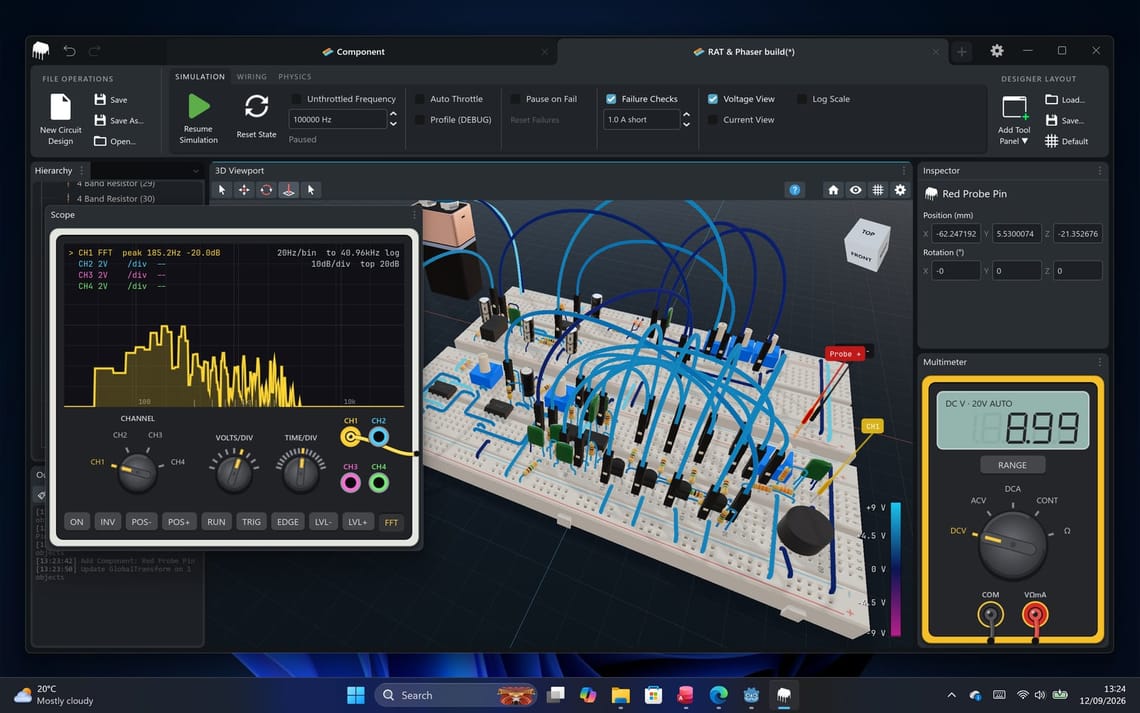
Imagine a workbench that never runs out of parts, where a wrong wire doesn't fry a $30 board and a full robot arm fits on your desktop. That's the pitch behind CRUMB, a 3D electronics simulator built by one developer, Mike Bushell. Its next version, CRUMB Advanced (2.0), is shaping up to be one of the most ambitious hobby sims on Steam.
CRUMB is sold on Steam, and the developer posts progress on Advanced on the official site:
What is CRUMB?
CRUMB launched on Steam on November 18, 2022. It's a real-time electronic circuit simulator, but instead of the flat schematic view most simulators use, everything happens on a 3D breadboard. You pick up resistors, LEDs, chips and jumper wires and wire them up just like at a real bench. When something goes wrong, nothing burns out and you don't have to order a replacement part.
The developer pitches it at beginners, hobbyists and students who want to practise next to their physical kits. Steam files it under Simulation, and it has a real following there: 78% of its 811 user reviews are positive, and in September 2026 Bushell announced 100,000 copies sold, with no publisher and no marketing budget.
What's in the current version (1.x)
The current desktop release (version 1.2 on Windows and macOS, according to the official development page) already covers a lot:
- Passives and switches: resistors, capacitors, inductors, potentiometers, tactile, slide and DIP switches
- Semiconductors: diodes, Zener diodes, BJT transistors, MOSFETs and SCRs
- Outputs: LEDs, seven-segment displays, buzzers, HD44780 character LCDs and an ST7735 TFT screen
- Chips: 555 timers, a long list of 74HC logic ICs, counters, a shift register, RAM, EEPROM and an LM741 op-amp
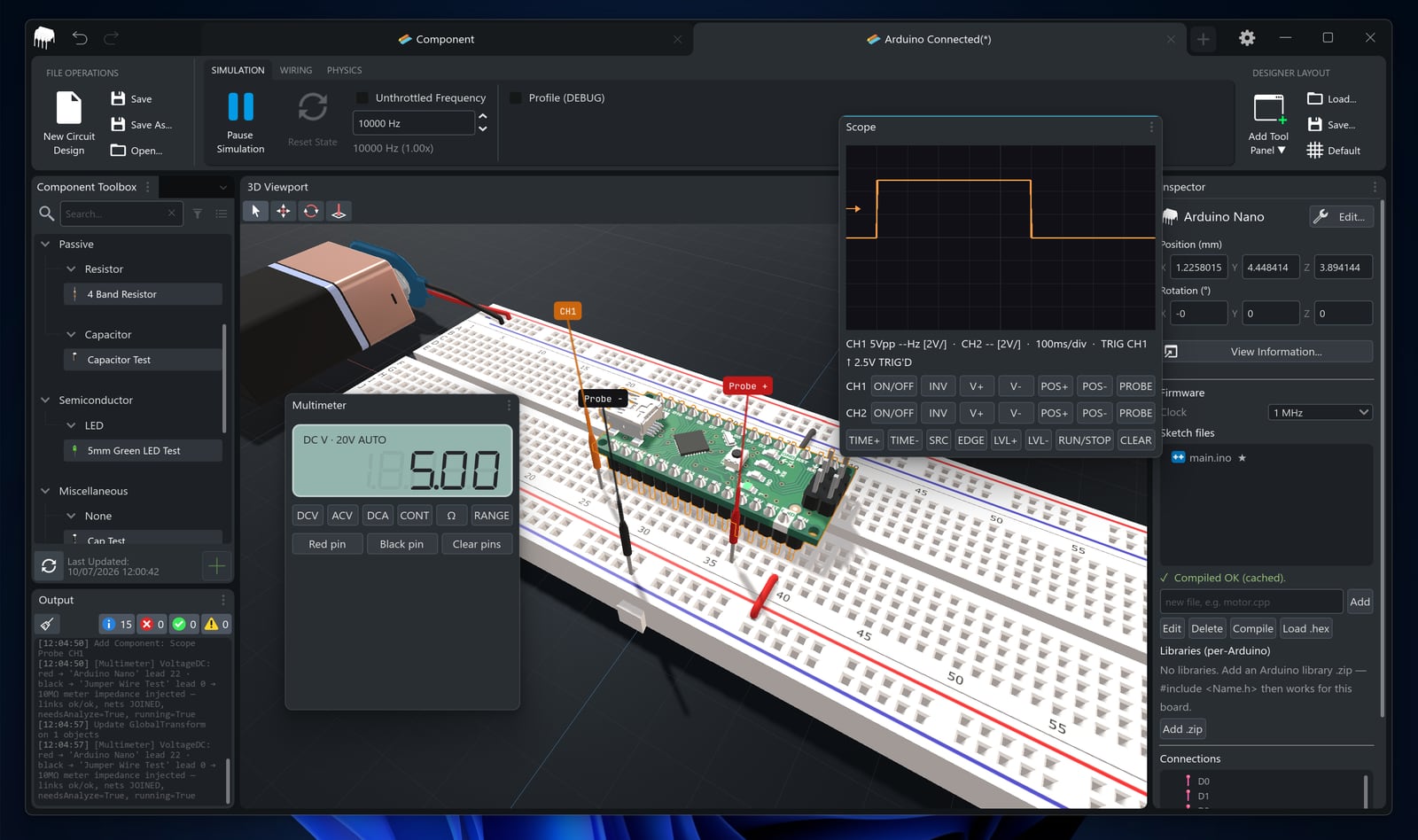
- Tools: a programmable Arduino Nano with a built-in code editor and serial monitor, a hex editor for EEPROMs, a 4-channel scope, and voltage/current views on the wires
Mobile versions for iOS and Android exist too, but they trail the desktop build (v1.0.3, with fewer parts).
CRUMB Advanced (2.0): the big rebuild

Version 2.0 started as an update. In a September 12 Steam post, Bushell explained that by the time he was done, "there was nothing left of the original", so it's becoming a separate product called CRUMB Advanced. He also admits that the first CRUMB "fell short of my original vision" and calls Advanced the version he meant to make.
How it works
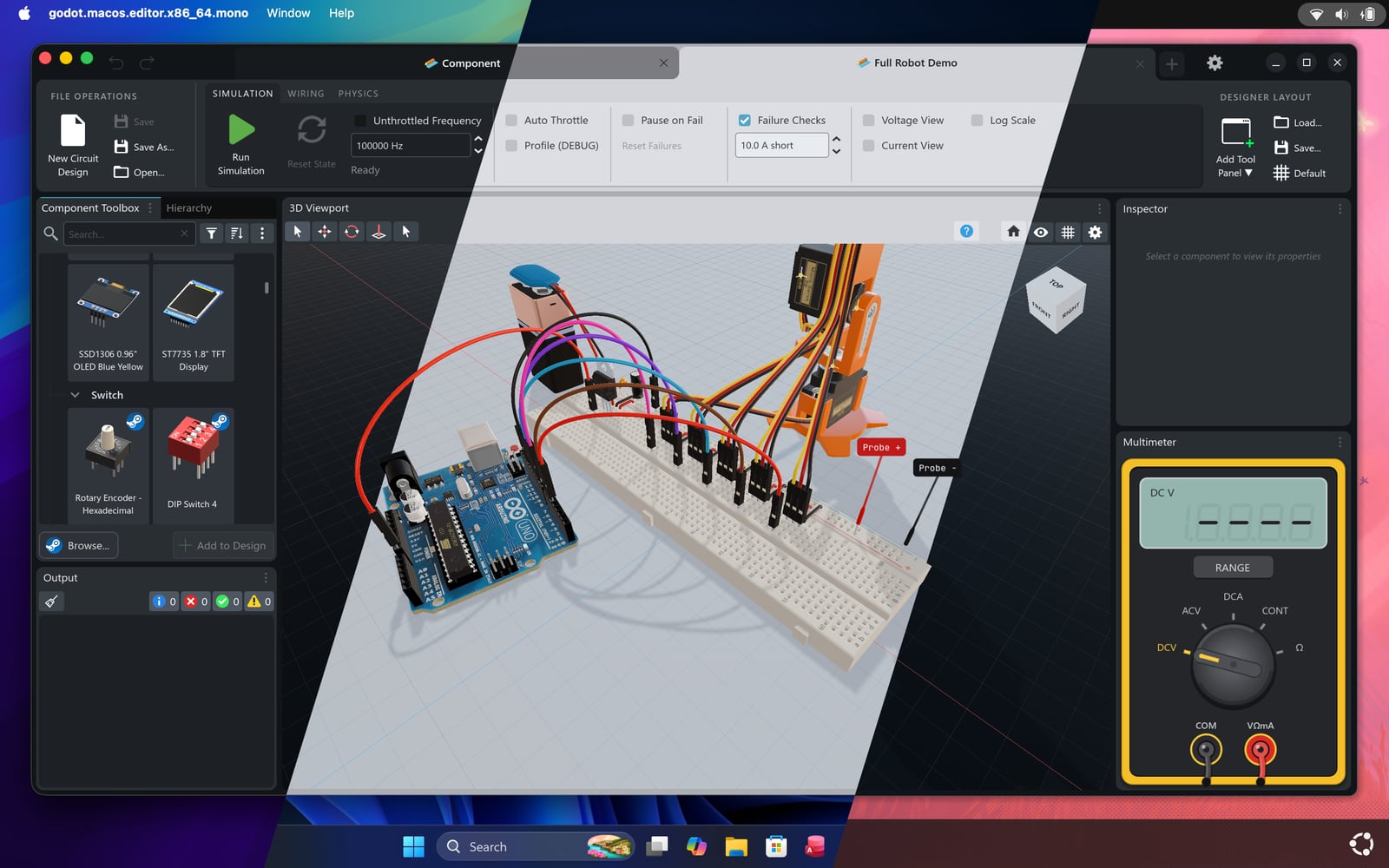
The 2.0 builds shown so far keep the 3D breadboard idea but add a pro-style workspace: a ribbon toolbar with simulation, wiring and physics tabs, a component toolbox, a hierarchy and inspector, and dockable instrument panels. You can set the simulation frequency, turn on failure checks (so a short circuit actually counts), and overlay voltage or current on the wires.
Key features announced so far
| Feature | What the developer says |
|---|---|
| Microcontrollers | Fully emulated boards from several families: Arduino, ESP32, Raspberry Pi and more |
| Instruments | A true oscilloscope with trigger edges and FFT analysis, plus a realistic multimeter |
| Physics | Rigid-body physics for building robots, environmental physics for sensor scenarios, and simulated Bluetooth/Wi-Fi for boards like the ESP32 |
| Custom parts | A component editor, programmable shaders for realistic parts, and Steam Workshop sharing |
| Built-in IDE | C# (.NET 8) scripting with code completion, live compilation and a strict sandbox so Workshop downloads stay safe |
| Real hardware | Flash a real Arduino R3 with the same code that's running in the sim |
| Audio | Low-latency audio input for real-time analog processing (he has played guitar through a simulated effects circuit) |
| Speed | Megahertz-level simulation in some setups; it can even run DOOM |
| Platforms | Native Windows 10/11, macOS and Linux |
Availability and pricing
- CRUMB Circuit Simulator (1.x): available now on Steam for $8.99 in the US (prices vary by region, e.g. €8.79 in the eurozone). The Steam version is Windows-only. The minimum PC is a 64-bit Core i3 with 4 GB RAM and integrated graphics.
- CRUMB Advanced (2.0): "coming soon", with no release date or price announced yet. It will get its own Steam store page.
- Free upgrade: anyone who owns the original CRUMB before the Advanced store page goes live will get Advanced free at release. Bushell confirmed this again on October 10, 2026, and says an optional supporter DLC is planned for people who want to chip in.
Why it matters
Most free circuit simulators are either flat schematic tools that beginners find abstract, or browser toys that stop at blinking an LED. CRUMB sits in between: it looks like the kit on your desk but runs on a proper simulation engine. If 2.0 delivers emulated ESP32 and Raspberry Pi boards, robot physics and Workshop parts, students could prototype a full robotics or IoT project before buying a single component. That matters most where parts are expensive or hard to import.
The upgrade policy also stands out. In a market full of paid "remasters", a solo developer giving existing buyers the full rebuild for free is rare.
Reality check
- No date, no price. Advanced is still in development. All we've seen are dev-build screenshots and videos, and 2.0 itself has been through what Bushell called "nearly 2 years of non-starts".
- Feature claims come from the developer. "Megahertz-level" speed applies only "in certain configurations", and nobody outside the project has tested emulated Pi or ESP32 Wi-Fi yet.
- Today's version has limits. Steam reviews are mostly positive, not overwhelmingly so, and Bushell himself calls the current Arduino support "not up to standard".
- It's one person. That explains the passion and the free upgrade, but it also means updates arrive at a solo developer's pace.
If you want in, there's one clear advantage to buying now: you'll own the original before the Advanced store page opens, and that's what qualifies you for the free upgrade.
Final thoughts
CRUMB began as a virtual breadboard and is turning into a full electronics lab, with real-looking instruments and simulated microcontrollers, robots and wireless. If Advanced ships close to what's been shown, it could become the go-to sandbox for anyone learning electronics. For about the price of a pack of jumper wires, the original is an easy way to get started now.
Would you learn electronics in a 3D simulator before buying real parts, or does nothing beat a soldering iron and a real breadboard? Let us know.
Sources: CRUMB Circuit Simulator on Steam, CRUMB official site, CRUMB development status, Steam announcements: “Looking for the most advanced electronics simulator in the world?” (Sep 12, 2026), “100,000 copies sold” (Sep 15, 2026), “Take a look at CRUMB Advanced” (Oct 10, 2026) and 2.0 dev diaries.